What is Social Language? The words between hello and goodbye?
Connecting Social Pieces with Autists
Welcome to the Different Skill Notebook Blog/Podcast. My name is Ana Anselma, your host. The different skill notebook discusses skills that promote quality of life, adaptation, and agency for autistics and those with related conditions. Typically, the discussions on autism and neurodivergence focus on behaviors and barriers resulting from the characteristics of autism. The focus should be on “the skills” that autistics need to thrive.
We cover what is involved in equipping an autistic learning style. All our topics are helpful for anyone seeking to equip and expand social communication, competency, and most importantly, self-management skills. In all our teaching strategies, our primary focus is seeking to further understand, support, and equip autistics.
Equipping individuals with autism requires different teaching strategies that consider the differences in autistic thinking, learning, and living.
Story:
The amazing experience of having the Center, it has been almost 15 years since Dr. Sandra Savinelli and I have been running social groups at the Social Mind Center. It has been 20 years since my son was diagnosed with autism.
And we've learned a great deal from autistics about their preferred communication styles. We currently have many children/young adults with a varied range of communication needs. Our typical client has language but lacks social language and communication skills.
What is always on my mind when working with an autistic person is they want to connect with others. Their process is unique. The social expectations and rules of engagement may not always be clear or obvious to them.
Always leading noting that autistics are managing great stress, anxiety or dysregulation in social situations impacting how easilty they navigate socialization.
Allowing them time and support to adjust to the environment is the best strategy. Giving them additional time to settle in or approach the group is always best.
When we provide greater social understanding of expectations and varying strategies for navigating social environments, always respecting their needs, there is an immediate mind shift for them.
In teaching social understanding, we show them how to read body language and the room (others’ intentions) in social situations. We teach self-awareness and help them regulate (organize mind and body) to adapt to uncomfortable situations.
What is critical to understand is that autistics need intentional instruction and coaching in these skill areas. These skills do not develop to the needed level to navigate environments independently without instruction.
When you find a voice to connect with others and advocate for your needs, you can adapt more easily. I see the joy and relief in every session as they acquire new knowledge and strategies to manage a range of social and emotional situations.
I also witness the frustration and anguish when a child or teen struggles after saying hello, trying to find the words to connect and sustain an interaction. No matter where you are on the spectrum, these three skill areas, social communication, social understanding/thinking, and self-regulation, are impacted to varying degrees and impacted enough that the autistic person will need support, instruction, understanding, and different teaching strategies to acquire skills in these areas.
We can expect any child with unmet needs to be very stressed and/or angry, resulting in behaviors when the reality is unrecognized needs. Typically, the focus shifts to behavior management rather than equipping autistics to address the skills gaps that lead to the behaviors, and to truly address the source of the need or skill gap, such as an inability to communicate one’s needs and experiences effectively.
“Communication is a human right. Not every autistic person can talk, but every autistic person communicates in their own way. Some autistic people need support to communicate, like Augmentative and Alternative Communication (AAC). AAC is a way to communicate without talking, like using picture cards, a letter board, or typing on an iPad. Autistic people need to get communication supports right away, no matter what other things we can or can’t do.
People should never have to “earn” the right to communication supports.
We need to make sure AAC is available for all autistic people, and that autistic people are supported to communicate in the way that works best for them.
“Autistic Self-Advocacy Network https://autisticadvocacy.org/about-asan/what-we-believe/
Skill - developing social language: for self-advocacy, self-management for independence.
Common misconceptions and misinformation related to the acquisition of social skills:
These social communication and competency skills will develop on their own, especially if the autistic individual has language
Being with neurotypical peers in school, they will be able to imitate and acquire social communication and competency from peers.
When an autistic person is non-verbal, there are many assumptions made about competency. Commonly, the assumption is made that because an autistic person cannot speak, they are unable to understand language (receptive language, the ability to understand spoken or written language). Therefore, the non-verbal autist receives limited instruction in the acquisition of language
Once the behaviors are quashed, the social communication and competency will evolve independently
So let’s focus on skill-based interventions.
Skill: Social Language and Communication
What is social language/communication? Daily, my consultations with parents unravel when they share the following statement my child has autism, and they cannot communicate/or build relationships. Another variation of this statement is that my child has autism, and they are unable to build relationships or develop or understand relationships, and struggle to converse.
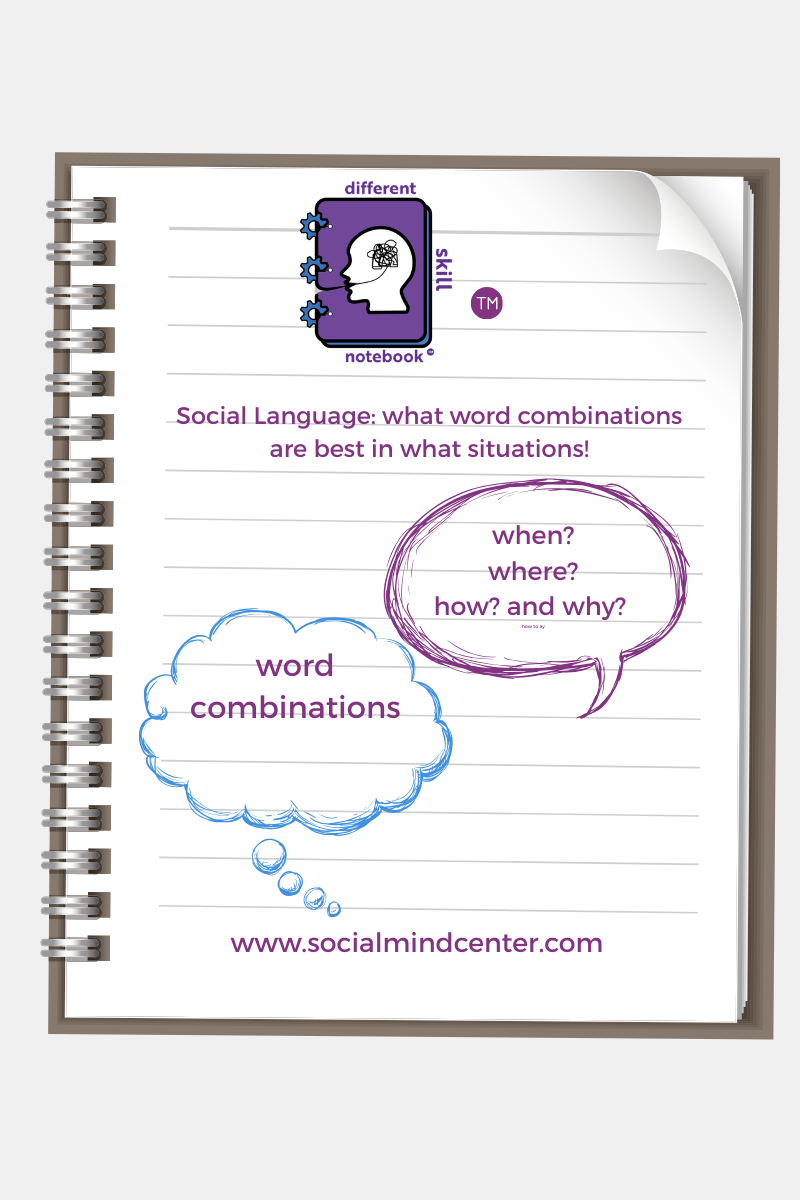
Social language is about which word combinations work best in which situations. The biggest misunderstanding about autism is that autistics will acquire social communication independent of instruction. Most people with autism will require lifelong support and instruction in this area.
Autistics need to adapt to environments that were not designed for their learning style, and they require instruction and support to do so. Environments rapidly change throughout the developing years. Language and social communication should evolve, developing with age and in response to environmental demands.
Social communication is how and why we use language to interact with other people.
Social Language is what word combinations are best in what situations (Expanded definition in the Resources section below):
the words between hello and goodbye:
Using language for different purposes such as:
Greeting (hello, goodbye)
Informing
Demanding
Requesting
Changing language per the needs of the listener and situation, such as:
Talking differently to a peer than to a teacher
Following rules of conversations and storytelling, such as:
Taking turns in conversation
Introducing topics of conversations
Strategies:
There are strategies that can help autistic people develop these skills while respecting their needs and desires.
So the toolbox for equipping and supporting social communication for autistics is expansive. The first step is to focus on the words they need to meet their needs and communicate what they want. Helping develop their voice to self-advocate and adapt to varying environments should always be the first priority. Developing social language, not just the words used in a social context, also involves informing, demanding, and requesting. The language intervention plan should always prioritize words needed for self-advocacy.
Real Time/In-person peer-to-peer interactions
For literal learners, it is so important to have real-time in-person communication practice
Learning social expectations for varying environments and situations. Learning manners and expected social rules and expectations. Understanding their own needs to adapt to the varying social situations
Developing scripts that they are comfortable with and that get their point across
Modeling helps them see and hear how to communicate
Role-playing is so important in building comfort and confidence through practice and achieving connections with peers
Practicing conversational exchanges
Feedback after role-playing an exchange. How did they feel, and how do they think they did?
Learning perspective-taking, how others' thoughts and feelings vary from your own.
Learning how to self-regulate in social situations when the environment may be stressful, sensory-altering, and/or anxiety-provoking. We will discuss this topic extensively.
In social communication, there are endless word combinations for all the social scenarios that may arise. We cannot have a script prepared for spontaneous or unexpected situations. This is where exposure really helps provide the experience to prepare for moments when they may feel uncomfortable or stressed. Stress and anxiety management (what to do when destressed) requires experience and practice. In the next article, self-regulation is discussed in depth and its impact on communication.
For autistics with limited language, it is always important to continue building vocabulary; however, words should be prioritized, with a focus on those used to navigate environments as independently as possible.
Communication is a two-way experience, so we must be very mindful to listen to autistics and respect their process. They are not a robot to be programmed. So we kind of need to meet each individual autistic halfway, sometimes all the way.
Leading with supporting and equipping in self-regulation assists in adaptation for all learning.
Resources:
Social Emotional Vocabulary:
Greeting, Joining in, Hanging out, Waiting, Sharing (taking turns), Respect, Responsibility, Problem solve, Cope, Calm, Stress, Help, Break, Stop, Friend, Kind, Mean, Safety, Choice, Consequence, Conversation,
Social communication is how and why we use language to interact with other people.
Social Languageis what word combinations are best in what situations:
Using language for different purposes such as:
Greeting (hello, goodbye)
Informing
Demanding
Promising
Requesting
Changing language per the needs of the listener and situation, such as:
Talking differently to peer than a teacher
Giving background information to an unfamiliar listener
Speaking differently in a classroom than a playground
Following rules of conversations and storytelling, such as:
Taking turns in conversation
Introducing topics of conversations
Staying on topic
Rephrasing when misunderstood
How to use verbal and non-verbal signals
How to close to stand to someone when speaking
How to use facial expressions and eye contact
https://www.asha.org/public/speech/development/social-communication/
Autism spectrum disorder DSM-5 diagnostic criteria: Full text
“ A. Persistent deficits in social communication and social interaction across multiple contexts, as manifested by the following, currently or by history (examples are illustrative, not exhaustive, see text):
Deficits in social-emotional reciprocity, ranging, for example, from abnormal social approach and failure of normal back-and-forth conversation, to reduced sharing of interests, emotions, or affect, to failure to initiate or respond to social interactions.
Deficits in nonverbal communicative behaviors used for social interaction, ranging, for example, from poorly integrated verbal and nonverbal communication; to abnormalities in eye contact and body language or deficits in understanding and use of gestures; to a total lack of facial expressions and nonverbal communication.
Deficits in developing, maintaining, and understanding relationships, ranging, for example, from difficulties adjusting behavior to suit various social contexts; to difficulties in sharing imaginative play or in making friends; to absence of interest in peers.
Specify current severity: Severity is based on social communication impairments and restricted repetitive patterns of behavior.
Work Cited:
Cuncic, A. How to Practice Self-Regulation. verywellmind. March 15, 2019; https://www.verywellmind.com/how-you-can-practice-self-regulation-4163536.
Center on the Developing Child at Harvard University (2011). Building the Brain’s “Air Traffic Control” System: How Early Experiences Shape the Development of Executive Function: Working Paper No. 11. Retrieved from www.developingchild.harvard.edu.
Philip D. Zelazo, P. D. 3 Areas of Executive Function. Understood.org. https://www.understood.org/en/learning-thinking-differences/child-learning-disabilities/executive-functioning-issues/types-of-executive-function-skills?_ul=1*1w7rvn5*domain_userid*YW1wLWIyV0U2a3FCUldLVEVzb3ZDZXpWRWc.
The National Center for Learning Disabilities. (2013). Executive Function 101. Retrieved from www.LD.org.
Meltzer, L.J. (2010). Promoting Executive Function in the Classroom. New York: Guilford Press.
Meltzer, L.J. (Ed). (2007). Executive Function in Education: From theory to practice. New York: Guilford Press.
Atwood, T. (2007). The Complete Guide to Asperger's Syndrome. London, England. Jessica Kingsley Publishers.